+86 18652221058
- English
- Chinese
- French
- German
- Portuguese
- Spanish
- Russian
- Japanese
- Korean
- Arabic
- Irish
- Greek
- Turkish
- Italian
- Danish
- Romanian
- Indonesian
- Czech
- Afrikaans
- Swedish
- Polish
- Basque
- Catalan
- Esperanto
- Hindi
- Lao
- Albanian
- Amharic
- Armenian
- Azerbaijani
- Belarusian
- Bengali
- Bosnian
- Bulgarian
- Cebuano
- Chichewa
- Corsican
- Croatian
- Dutch
- Estonian
- Filipino
- Finnish
- Frisian
- Galician
- Georgian
- Gujarati
- Hausa
- Hawaiian
- Hebrew
- Hmong
- Hungarian
- Icelandic
- Igbo
- Javanese
- Kannada
- Kazakh
- Khmer
- Kurdish
- Kyrgyz
- Latin
- Latvian
- Lithuanian
- Luxembou..
- Macedonian
- Malagasy
- Malay
- Malayalam
- Maltese
- Maori
- Marathi
- Mongolian
- Burmese
- Nepali
- Norwegian
- Pashto
- Persian
- Punjabi
- Serbian
- Sesotho
- Sinhala
- Slovak
- Slovenian
- Somali
- Samoan
- Scots Gaelic
- Shona
- Sindhi
- Sundanese
- Swahili
- Tajik
- Tamil
- Telugu
- Thai
- Ukrainian
- Urdu
- Uzbek
- Vietnamese
- Welsh
- Xhosa
- Yiddish
- Yoruba
- Zulu
- Kinyarwanda
- Tatar
- Oriya
- Turkmen
- Uyghur

What Should Buyers Ask A China Crane Motor Controller Manufacturer Before An RFQ? | Xuzhou Jiemanda Construction Machinery Co . , Ltd.
Direct Answer: Before sending an RFQ to a China crane motor controller manufacturer, first confirm whether the company manufactures, repairs, programs, stocks or sources the requested unit. Then request evidence for product identity, condition, configuration capability, functional testing, traceability, packaging and after-sales responsibility. For obsolete controller families, the quotation must also define provenance and remaining support options.
The word “manufacturer” is often used broadly in online sourcing. A buyer may receive responses from original manufacturers, aftermarket producers, repair specialists, wholesalers, stockists and trading companies. Those businesses can all be useful, but they do not offer the same product, evidence or responsibility. Supplier qualification should therefore begin with the supplier’s actual role in the transaction.
Jiemanda’s company profile positions it as a construction machinery parts supplier and OEM customization service provider for the aftermarket. Buyers can review the company’s stated scope on the Jiemanda company page, but a controller RFQ should still ask who made the offered unit, who tested it, who controls any required software, and who will handle a compatibility dispute.
What Does “Manufacturer” Mean for This Specific Quotation?
Ask the respondent to select and explain its role: original product manufacturer, authorized channel, independent aftermarket manufacturer, remanufacturer, repair workshop, stockist, sourcing supplier or programming service provider. Do not treat these terms as interchangeable.
For a current generic controller, manufacturing capability might center on design, assembly and production testing. For an older branded controller, the practical value may instead come from identifying original stock, testing used units, restoring hardware, preserving configuration data or supplying a retrofit path. The relevant evidence changes with the role.
A supplier that openly defines its boundary can be easier to evaluate than one that claims to do everything. If programming is performed by a third party, for example, the buyer should know who receives the machine data, how version control is managed and which party is responsible if the unit communicates but does not match the crane.
Is the Requested Product a Motor Controller, Hydraulic Controller or Safety-System Controller?
Keyword categories do not always match engineering functions. A crane motor controller may regulate an electric drive, while a hydraulic controller may command valves or process joystick signals. A crane safety controller may acquire boom geometry and load-related inputs, calculate operating limits and communicate with a display or protection circuit.
The WIKA iFLEX E5/0101 crane dedicated controller is listed as a unit that processes signals associated with load-moment limiters, angle sensors and length sensors. A supplier should not confirm it merely because the buyer’s RFQ says “winch controller” or “hydraulic controller.” The machine function and installed system must be reconciled first.
Ask the supplier to repeat back its understanding of the application in writing. The response should identify the controller’s role, the crane model, the connected components and the proposed supply condition. This simple step exposes many misunderstandings before money or shipping time is committed.
How Should Buyers Question the Status of a Legacy iFLEX E5 Unit?
WIKA Mobile Control’s published discontinuation notice states that the iFLEX E5 series became obsolete in its product portfolio effective October 1, 2021. An RFQ for the E5/0101 should therefore ask where the offered unit comes from and what type of supply it represents.
- Unused old stock: ask about storage conditions, packaging history and whether seals or connectors have deteriorated.
- Used original unit: ask for operating history if available, incoming condition and test results.
- Repaired or remanufactured unit: ask what was repaired, which components were replaced and how the repair was verified.
- Compatible alternative: ask for an engineering comparison, required adapters, data migration and commissioning plan.
A quotation should not hide these categories behind the single word “new.” Buyers need a condition declaration that can be used during receipt inspection and any later claim.
What Product-Source and Traceability Evidence Is Reasonable?
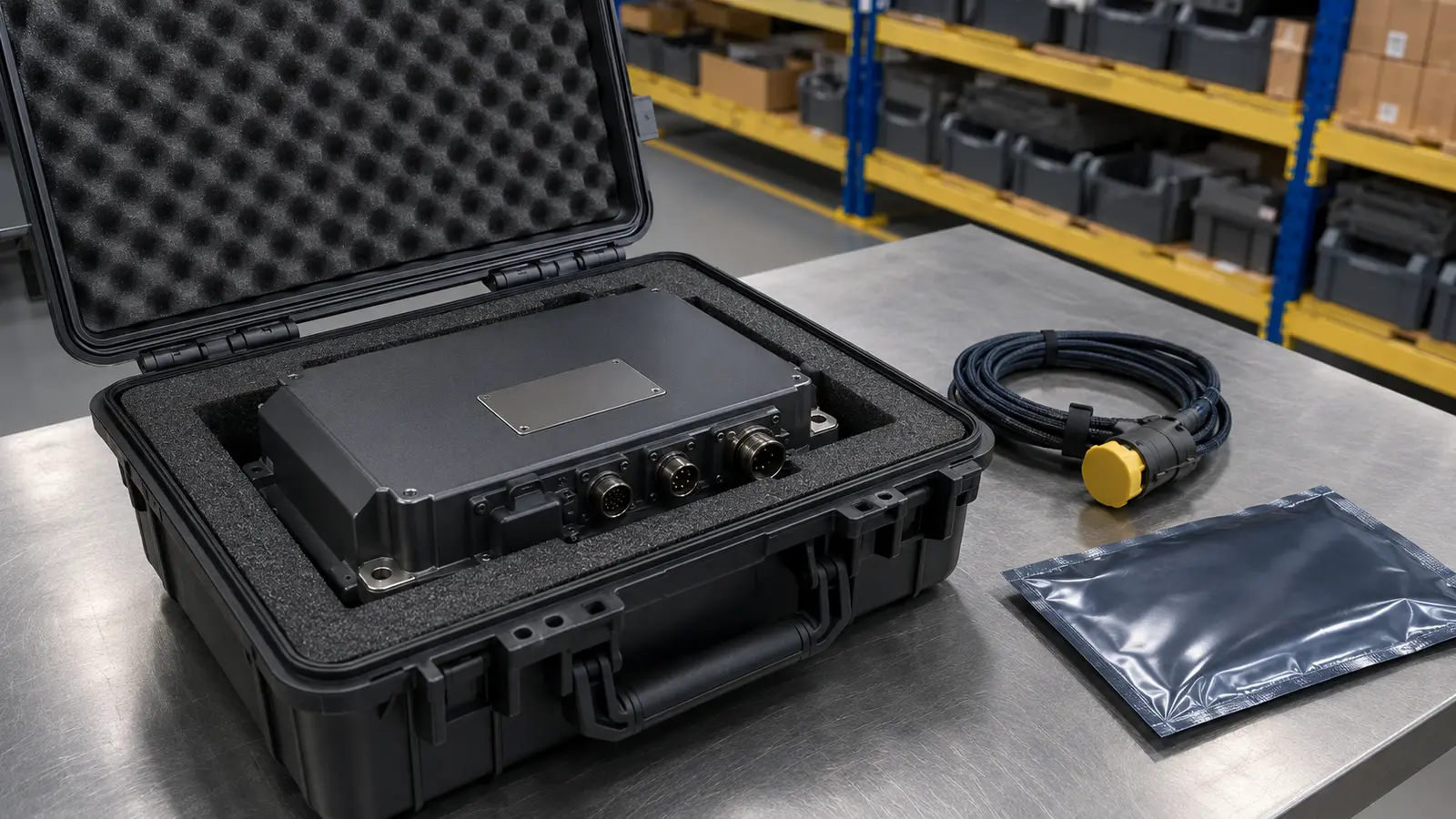
Request current photographs of the actual offered unit or clearly identified batch, including the full nameplate, serial information, connectors, housing and mounting features. Catalog photographs can support identification, but they do not prove what will be shipped.
Ask how the supplier records the relationship between the quotation, inspected unit, packing list and shipment. For a scarce legacy component, a serial-number photo or another unique visual record can prevent substitution between approval and dispatch.
If a supplier claims an original, unused or factory-programmed item, request evidence appropriate to that claim. The buyer does not need a pile of unrelated certificates; the evidence should directly support the origin, condition or configuration being sold.
Which Testing Questions Separate a Useful Quote From a Weak One?
“Fully tested” has little value unless the supplier defines the test. Ask what equipment is used, which functions are stimulated, which outputs are observed, how long the unit is operated and which result is recorded. A bench may verify power, communication and selected I/O, but it may not reproduce the entire crane system.
For a controller involved in a load-moment or safety system, the supplier should distinguish between component-level testing and crane-level acceptance. A video of indicator lights can demonstrate something, but it does not prove that the controller contains the correct load chart, sensor calibration or machine configuration.
Ask for a pre-shipment evidence package tied to the approved unit. This can include label photographs, connector condition, a concise test checklist and packing confirmation. The buyer should also state which tests must be repeated after installation.
Who Is Responsible for Software, Parameters and Data?
Some controllers are hardware-only purchases; others depend on crane-specific software, parameters, calibration or configuration files. The supplier should state whether the unit is blank, programmed, copied, repaired without changing data, or supplied with an agreed configuration.
Ask what information is required from the buyer and whether the original unit must be readable. If the crane’s existing controller still communicates intermittently, delaying data recovery until after removal or further damage can increase project risk.
The RFQ should name the party responsible for data extraction, file preparation, loading, version approval and post-installation correction. It should also address confidentiality when machine files or customer-specific data are shared. A low component price can become expensive if programming is excluded and no qualified party can complete it at the destination.
How Should the Supplier’s Broader Capability Be Checked?
Review whether the supplier understands the surrounding crane control system, not only the controller. Jiemanda’s construction machinery parts catalog covers multiple electrical and control-related product groups, while the dedicated controller category shows the relevant sourcing scope.
Adjacent knowledge can matter when the apparent controller fault is caused by a sensor, display, harness or board. The site’s crane motherboard category is one example of a related product group, but catalog breadth alone does not prove diagnostic capability. Ask for the actual workflow used to review part numbers, photographs, fault symptoms and system relationships.
A strong response should be willing to identify missing information and delay confirmation when evidence is insufficient. Immediate assurance based only on one photograph may indicate that the supplier has not evaluated the real compatibility risk.
Which Commercial Terms Should Be Fixed Before Comparing Price?
| RFQ Area | Question to Ask | Acceptable Evidence or Term |
|---|---|---|
| Supplier role | Who manufactures, sources, repairs, tests and programs the unit? | Written responsibility statement |
| Product status | Is it old stock, used, repaired, remanufactured or an alternative? | Condition declaration with current photos |
| Compatibility review | Which machine and system data were checked? | Part-number and interface comparison record |
| Functional test | What can the bench test prove and not prove? | Named test scope and result evidence |
| Configuration | Who supplies and approves software or parameters? | Defined data workflow and exclusions |
| Claims | What happens if the shipped unit differs or fails agreed tests? | Inspection window and remedy terms |
| Logistics | How are connectors and electronics protected? | Packing method and shipment documentation |
Price comparisons are meaningful only after these boundaries are aligned. One quote may include inspection, programming and protected packing, while another covers only an unverified component. Buyers should normalize the scope before concluding that one supplier is cheaper.
What Should a Remote Supplier Audit Include?
A remote audit does not need to become a staged factory tour. Ask the company to show the area relevant to the quotation: incoming identification, inspection tools, test setup, storage, labeling and packing. Request live views or recent records linked to the controller type where practical.
Check whether the commercial contact can involve a technical person when questions move beyond price. Ask how nonconforming parts are quarantined, how customer approval is recorded and how the shipped unit is linked to the pre-shipment evidence. These operational details reveal more than generic claims about quality.
For repeat procurement, agree on a reusable identification form. A consistent format for crane information, old-part labels, connector photographs, fault symptoms and required condition reduces variation between branches, technicians and future orders.
Representative Scenario: A Distributor Qualifies Two Different Supplier Types
Representative scenario — not a claimed customer case.
Business Background: A regional crane-parts distributor receives an urgent request for an iFLEX E5/0101 used in an older machine.
Problem: One respondent calls itself a manufacturer and offers a low price; another describes itself as a parts supplier and offers a higher-priced tested original unit.
Cause: The quotations do not use the same condition definition, test scope, configuration responsibility or claim terms, so the prices cannot be compared directly.
Solution: The distributor issues a revised RFQ that requires each respondent to declare its role, item condition, source evidence, serial photographs, test boundary, software responsibility, packing and remedy terms.
Buyer Decision Value: The buyer can now select by documented supply scope and risk rather than by the “manufacturer” label or unit price alone.
What Should Be Included in the Final RFQ Package?
- Buyer company, destination country and intended use.
- Crane manufacturer, model, serial number, year and system description.
- Full controller labels, connector photographs and mounting photographs.
- Observed fault, diagnostic work completed and current machine status.
- Required product condition and acceptable alternatives.
- Required software, parameters, data recovery or programming service.
- Pre-shipment test evidence and receipt-acceptance requirements.
- Quantity, packing, shipping deadline and delivery destination.
- Warranty or remedy expectations and technical-support boundary.
Buyers can send this package through the Jiemanda RFQ contact page. The request should ask for a written response to unresolved items, not merely a price and delivery estimate.
Frequently Asked Questions
Is every China crane motor controller manufacturer an original manufacturer?
No. Search results may include manufacturers, remanufacturers, repair companies, stockists, distributors and sourcing suppliers. Ask each company to define its role.
Why should buyers ask whether the controller family is obsolete?
Obsolescence changes availability, condition, software support and future replacement options. It should affect both the immediate purchase and lifecycle plan.
What evidence supports an “original” controller claim?
Request complete label and serial photographs, current unit images, source documentation where available, and a condition statement tied to the shipped unit.
Does a bench test prove the controller will work on the crane?
Not by itself. Bench testing can verify selected functions, but crane-level compatibility also depends on wiring, sensors, communication, configuration and commissioning.
Should programming be included in the controller price?
It may or may not be included. The quotation should explicitly state the software and parameter scope, required buyer inputs and responsibility for corrections.
How can buyers compare quotations with different product conditions?
Normalize the condition, identity evidence, test scope, configuration work, packing, claim terms and support before comparing the unit price.
What is the most useful first document for supplier qualification?
A structured RFQ that combines machine data, old-part evidence, required condition, test expectations and responsibility boundaries is more useful than a generic supplier questionnaire alone.
Feature Product
-
 Zoomlion Original Power Control Board – ...
🔹 Core Functions Multi-circuit Power Distrib...
-
 XCMG HC3900 Crane Upper Computer Mainboard
Key Selling Points OEM Direct Compatibility ...
-
 Zoomlion Mobile Crane Load Moment Indicator (LM...
Product Overview This is an original equipment...