
+86 18652221058
- English
- Chinese
- French
- German
- Portuguese
- Spanish
- Russian
- Japanese
- Korean
- Arabic
- Irish
- Greek
- Turkish
- Italian
- Danish
- Romanian
- Indonesian
- Czech
- Afrikaans
- Swedish
- Polish
- Basque
- Catalan
- Esperanto
- Hindi
- Lao
- Albanian
- Amharic
- Armenian
- Azerbaijani
- Belarusian
- Bengali
- Bosnian
- Bulgarian
- Cebuano
- Chichewa
- Corsican
- Croatian
- Dutch
- Estonian
- Filipino
- Finnish
- Frisian
- Galician
- Georgian
- Gujarati
- Hausa
- Hawaiian
- Hebrew
- Hmong
- Hungarian
- Icelandic
- Igbo
- Javanese
- Kannada
- Kazakh
- Khmer
- Kurdish
- Kyrgyz
- Latin
- Latvian
- Lithuanian
- Luxembou..
- Macedonian
- Malagasy
- Malay
- Malayalam
- Maltese
- Maori
- Marathi
- Mongolian
- Burmese
- Nepali
- Norwegian
- Pashto
- Persian
- Punjabi
- Serbian
- Sesotho
- Sinhala
- Slovak
- Slovenian
- Somali
- Samoan
- Scots Gaelic
- Shona
- Sindhi
- Sundanese
- Swahili
- Tajik
- Tamil
- Telugu
- Thai
- Ukrainian
- Urdu
- Uzbek
- Vietnamese
- Welsh
- Xhosa
- Yiddish
- Yoruba
- Zulu
- Kinyarwanda
- Tatar
- Oriya
- Turkmen
- Uyghur

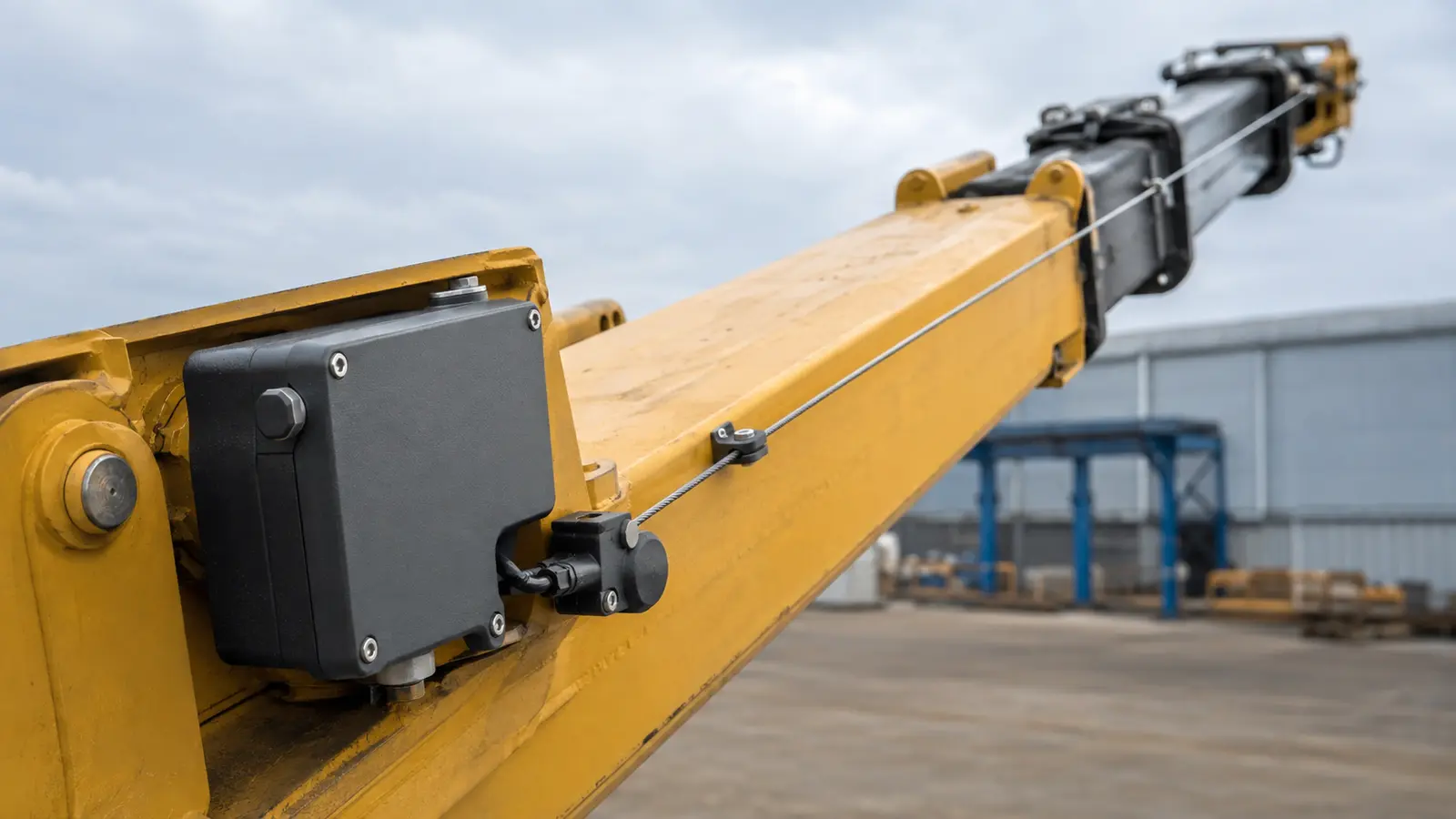
Direct answer: An LWG152 angle sensor for a crane should be selected as part of a complete length-and-angle measurement assembly, not as an isolated angle component. Confirm the LMI family, crane type and tonnage, boom travel, angle range, 4–20 mA signal requirements, connector pinout, mounting orientation, cable routing, and enclosure protection before comparing offers. The published LWG152 configuration is associated with HIRSCHMANN HC 3900-series systems, a 15 m reel, 0–14 m boom-length measurement, 0–85° angle measurement, IP65 protection, and 20–50 ton cranes; the actual machine record must still validate the application.
This approach prevents a common purchasing error: treating “angle sensor for crane” as a generic product name. In an LMI system, boom length and boom angle are inputs to a larger safety calculation. A sensor assembly can be mechanically similar to the original and still be unsuitable because its ranges, output, wiring, or mounting geometry differ.
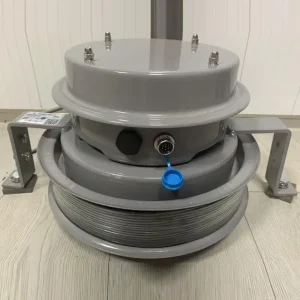
What the LWG152 Assembly Does
The LWG152 cable reel sensor assembly combines a retracting cable mechanism with length and angle sensing functions for crane boom monitoring. As the boom extends, the cable movement provides a representation of telescopic length. The angle channel represents boom elevation. These signals are transmitted to the LMI or controller, which uses them with other machine inputs.
That relationship explains why buyers must evaluate more than sensor range. The system depends on four interfaces working together:
- Mechanical interface: the housing, bracket, cable exit, and anchor must fit the boom arrangement.
- Measurement interface: the available cable travel and angle range must cover the crane’s operating geometry.
- Electrical interface: signal type, supply, wiring, and connector must match the receiving system.
- Configuration interface: the LMI must interpret the installed signals with the correct calibration and crane data.
A problem at any one interface can appear as a sensor fault. For example, a stable 4–20 mA current may still represent the wrong physical range if the controller expects a different scaling. Likewise, correct electrical output does not prevent cable wear caused by poor reel alignment.
Where the Published LWG152 Configuration Fits
Jiemanda’s current product information places the LWG152 in the following application window:
| Published item | LWG152 configuration | What the buyer should verify |
|---|---|---|
| Compatible LMI system | HIRSCHMANN HC 3900 series | Exact controller/LMI model, software or machine configuration, and connector interface |
| Cable reel length | 15 m | Definition of reel length, usable measurement travel, and reserve turns |
| Boom length range | 0–14 m | Actual telescopic measuring path from retracted to extended position |
| Angle range | 0–85° | Installed zero reference, orientation, and required operating range |
| Signal output | 4–20 mA | Channel count, supply, pinout, scaling, direction, and fault-state behavior |
| Protection class | IP65 | Exposure to dust, rain, pressure washing, salt, chemicals, and connector sealing |
| Suitable crane tonnage | 20–50 ton | Specific crane model and boom geometry rather than rated capacity alone |
These values define a preliminary selection boundary; they are not a universal approval. Crane tonnage is especially easy to overuse as a shortcut. Two 25-ton cranes can have different boom travel, brackets, LMI versions, and wiring. The equipment model and original assembly identification remain the decisive references.
Seven Compatibility Checks Before an RFQ
1. Identify the complete LMI chain
Record the display or controller model, the existing sensor assembly model, the crane make and model, and any intermediate junction box or harness. A photo of the display alone is not enough. The RFQ should show how the length-and-angle assembly connects to the system and whether the existing harness will be retained.
If the buyer cannot confirm the LMI family, capture every readable label and connector view. The supplier can then identify missing information without guessing.
2. Separate cable length from measuring range
A 15 m reel and a 0–14 m boom-length range are related but not identical specifications. Part of the cable and spring travel may be required for routing, anchoring, reserve turns, and safe retraction. Buyers should provide the retracted and extended distances along the actual cable path.
The cable must remain tensioned without approaching a hard mechanical limit. Its guide points should produce a clean, repeatable path with minimal side pull. If the original cable failed near the outlet, the inquiry should include photographs of the guide and anchor rather than assuming that replacement of the reel alone will solve the cause.
3. Verify the angle reference and installation orientation
An angle range of 0–85° is meaningful only when the zero reference and mounting orientation are understood. A sensor installed in a different orientation may produce a reversed, offset, or mechanically restricted reading. Freeze the housing position, bracket geometry, connector direction, and reference position used during commissioning.
Do not request a supplier to “precalibrate for the crane” unless the necessary machine data and expected procedure are defined. Final system validation normally depends on the crane installation and controller configuration.
4. Confirm every electrical detail behind “4–20 mA”
Signal type is only the first line of an electrical specification. Buyers should establish how many measurement channels are present, which terminal carries each signal, what supply is required, how grounds or returns are arranged, and what physical values correspond to the current range. Confirm whether current direction rises or falls with boom extension and elevation.
A connector that physically mates can still have a different pin assignment. The safest approval record includes both connector orientation and a numbered pinout. Wire colors may be recorded as supporting evidence, but should not be the only identification method because colors can change between harness versions or repairs.
5. Compare mounting and envelope dimensions
Record the bolt pattern, mounting-face dimensions, cable outlet position, overall depth, and clearance to the boom or nearby covers. The housing should sit squarely, and the cable should leave the reel in the intended direction. Avoid field drilling or bracket modification until the supplier has reviewed the mismatch; changing the position can affect both cable tracking and angle reference.
6. Match environmental protection to the installation
IP65 indicates protection against dust ingress and water jets under the conditions of the relevant enclosure test. It does not automatically cover submersion, high-pressure washing at close range, damaged cable glands, or an improperly seated connector. Buyers should state the actual environment and inspect the complete sealing path, including plugs and glands.
For outdoor cranes, look for corrosion at mounting faces, damaged coatings, brittle seals, and moisture paths along the cable. The correct product can still fail prematurely if the installation leaves a connector facing pooled water or if a missing cover exposes the housing.
7. Define how compatibility will be accepted
Specify the evidence required before shipment and the checks to be completed after installation. This turns “compatible” into an auditable decision.
- Pre-shipment identity photos of the model label, housing, cable end, connector, and mounting face.
- Dimensional comparison against the original or approved installation drawing.
- Smooth extension and retraction through the agreed usable travel.
- Electrical output checks at defined length and angle positions.
- Continuity and pinout confirmation.
- Post-installation verification of displayed length and angle at known reference positions.
LWG152 Versus LWG208: Do Not Select by Model Number Alone
The supplier’s comparison identifies LWG208 as a larger-range option with a 20 m reel, 0–19 m boom-length measurement, the same published 0–85° angle range and 4–20 mA output, IP65 protection, and a stated 50–100 ton crane application. This makes the difference easy to describe, but it should not be reduced to “small crane versus large crane.”
Changing from LWG152 to LWG208 may affect mounting, cable mechanics, system calibration, and physical clearance. Even when the signal format appears compatible, the receiving LMI must be configured for the actual sensor relationship and crane geometry. Buyers considering alternatives should compare the exact interfaces line by line and involve the equipment’s qualified service procedure.
For other constructions and brands, the crane cable reel box range provides a product-family view, while the angle sensor category covers separate angle-sensing products. The two categories overlap in function but are not interchangeable product definitions.
Common Buyer Mistakes
Ordering from the crane capacity only. Rated tonnage narrows the search but does not establish boom travel, LMI configuration, bracket geometry, or wiring.
Assuming all 4–20 mA devices are equivalent. The same current format can represent different ranges, directions, channels, and fault behavior.
Approving a sample from exterior photos. A visual match cannot prove pinout, signal scaling, cable reserve, spring condition, or angle reference.
Ignoring the cause of the original failure. Cable abrasion, side pull, damaged guides, connector corrosion, or incorrect controller settings can damage or misrepresent a new assembly.
Using installation calibration to hide a hardware mismatch. Calibration may correct a defined offset within the intended system. It should not be used to compensate for the wrong sensor range, signal type, or mechanical installation.
RFQ Information That Saves a Second Technical Review
A complete RFQ should include:
- Crane manufacturer, model, serial number, year, and rated capacity.
- LMI display/controller model and software or configuration reference if available.
- Original LWG152 assembly label and part-number photographs.
- Retracted and extended measuring-path dimensions.
- Mounting face, bolt pattern, cable outlet, connector, and cable-anchor photographs.
- Expected 4–20 mA channel behavior and pin assignment.
- Operating environment, quantity, packaging, delivery destination, and required inspection records.
- Whether the order is a replacement, retrofit, trial sample, or repeat batch.
For missing information, identify the gap instead of filling it with an assumption. A supplier can ask a precise follow-up question when the original label or connector is unclear; it is much harder to recover after an unverified configuration has entered production or international shipping.
Buyers can submit the LWG152 application details for a compatibility review with the machine, LMI, installation, and electrical information attached. The goal of the review should be a documented match, not a promise based on the product name alone.
Frequently Asked Questions
Is the LWG152 only an angle sensor?
No. It is presented as a cable reel sensor assembly for both boom-length and angle measurement. Buyers should evaluate the full assembly and its relationship with the LMI system.
Can an LWG152 be selected only because the crane is rated between 20 and 50 tons?
No. The stated tonnage range is an application guide. The crane model, boom measuring path, LMI compatibility, mounting, connector, and signal mapping must also match.
Does a 4–20 mA output guarantee electrical compatibility?
No. Confirm the supply, channel count, pinout, scaling, current direction, grounding arrangement, and how the receiving controller interprets each channel.
What should be checked after installation?
Check cable routing and retraction first, then verify the displayed boom length and angle at known reference positions. Follow the crane and LMI service procedures for calibration and safety validation before returning the machine to lifting work.
Selection Principle
An LWG152 is a suitable candidate when the complete application—not just the keyword—matches its mechanical, electrical, measurement, and system boundaries. Freeze the machine identity, LMI interface, length and angle ranges, signal map, installation geometry, environment, and acceptance evidence in the RFQ. That disciplined record makes supplier offers comparable and gives the maintenance team a clear basis for installation and commissioning.
Feature Product
-
 Zoomlion Original Power Control Board – ...
🔹 Core Functions Multi-circuit Power Distrib...
-
 XCMG HC3900 Crane Upper Computer Mainboard
Key Selling Points OEM Direct Compatibility ...
-
 Zoomlion Mobile Crane Load Moment Indicator (LM...
Product Overview This is an original equipment...