+86 18652221058
- Chinese
- French
- German
- Portuguese
- Spanish
- Russian
- Japanese
- Korean
- Arabic
- Irish
- Greek
- Turkish
- Italian
- Danish
- Romanian
- Indonesian
- Czech
- Afrikaans
- Swedish
- Polish
- Basque
- Catalan
- Esperanto
- Hindi
- Lao
- Albanian
- Amharic
- Armenian
- Azerbaijani
- Belarusian
- Bengali
- Bosnian
- Bulgarian
- Cebuano
- Chichewa
- Corsican
- Croatian
- Dutch
- Estonian
- Filipino
- Finnish
- Frisian
- Galician
- Georgian
- Gujarati
- Haitian
- Hausa
- Hawaiian
- Hebrew
- Hmong
- Hungarian
- Icelandic
- Igbo
- Javanese
- Kannada
- Kazakh
- Khmer
- Kurdish
- Kyrgyz
- Latin
- Latvian
- Lithuanian
- Luxembou..
- Macedonian
- Malagasy
- Malay
- Malayalam
- Maltese
- Maori
- Marathi
- Mongolian
- Burmese
- Nepali
- Norwegian
- Pashto
- Persian
- Punjabi
- Serbian
- Sesotho
- Sinhala
- Slovak
- Slovenian
- Somali
- Samoan
- Scots Gaelic
- Shona
- Sindhi
- Sundanese
- Swahili
- Tajik
- Tamil
- Telugu
- Thai
- Ukrainian
- Urdu
- Uzbek
- Vietnamese
- Welsh
- Xhosa
- Yiddish
- Yoruba
- Zulu
- Kinyarwanda
- Tatar
- Oriya
- Turkmen
- Uyghur

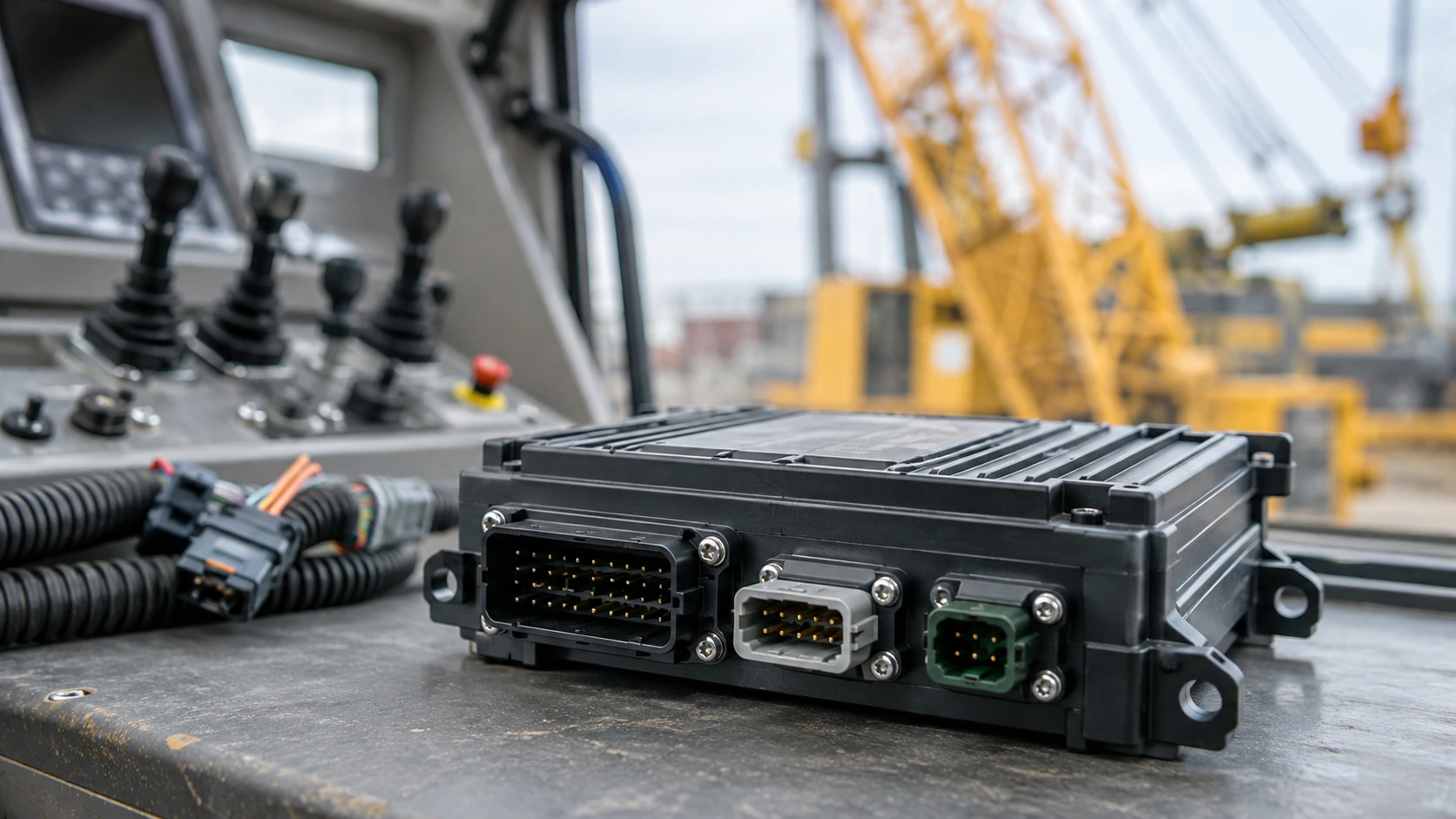
Direct answer: what proves replacement crane controller compatibility?
Why is the controller part number alone sometimes insufficient?
A full part number is the first matching field, not always the last. Controllers within one family may use the same enclosure while differing in hardware revision, connector population, I/O assignment, communication setup or application program. A worn label, shortened number copied from an invoice or photo of the casing can therefore lead to a visually convincing but unusable replacement.
Buyers should first review the available construction machinery controller category, then compare the candidate against the complete original-controller evidence. If the original unit cannot be read electronically, record every visible identifier before it is disconnected or sent for repair.
| Compatibility field | Evidence from original unit | Evidence from proposed unit | Decision risk if omitted |
|---|---|---|---|
| Manufacturer and complete part number | Clear label photo and transcription | Supplier label photo or product record | Wrong controller family or application |
| Hardware revision | Revision field on label or service record | Exact supplied revision | Changed circuits, I/O or connector behavior |
| Machine identity | Brand, model, serial number and year | Confirmed application scope | Controller supplied for a different machine configuration |
| Electrical interface | Supply, grounding, connectors and pinout | Matching electrical data | No power, damaged circuit or incorrect command |
| Communications | CAN or other network information where available | Protocol and configuration confirmation | Controller powers up but does not communicate |
| Software and parameters | Version, backup or commissioning record | Loading or configuration status | Correct hardware performs the wrong application logic |
Which machine and application identifiers should buyers capture first?
Record the crane brand, complete model, serial number, production year and the system controlled by the unit. The same controller family may be used across cranes, aerial work platforms or other mobile machinery, but the application program and connected devices may differ. Buyers should also state why the controller is being replaced, which fault codes are present and whether the original unit still communicates.
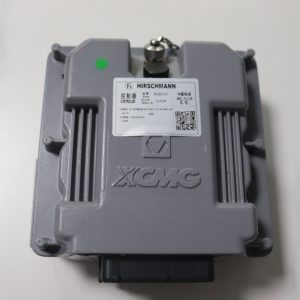
A distributor receiving only “XCMG crane controller needed” does not yet have enough information for a defensible quotation. Even an apparently relevant unit such as the XCMG Hirschmann iFLEX C3 controller must be matched to the actual application evidence instead of brand name alone.
How should supply voltage, connectors, pinout and I/O be compared?
First confirm the expected supply voltage, polarity, grounding arrangement and protection. Then compare connector type, keying, locking method, cavity count and every used pin. Identical-looking connectors do not guarantee identical pinouts. A connector that physically mates can still place power, ground, sensor and output circuits on different pins.
The input/output map should identify connected sensors, switches, solenoids, valves, relays and feedback circuits. Note whether channels are analog, digital, frequency-based or otherwise configured. This prevents a common hidden cost: buying the correct hardware family and then losing additional days tracing why the machine harness does not match the proposed allocation.
Which CAN details can prevent a controller from communicating?
“CAN compatible” is not a complete specification. The controller and machine must use compatible protocol behavior, baud rate, node or address settings and message expectations. Network termination, harness condition and other nodes can also create faults that resemble a defective controller.
Where the machine documents these details, include them in the RFQ. Where they are unavailable, say so explicitly and request a verification path. Do not assume that the presence of CAN terminals means the proposed unit contains the correct application or will automatically join the machine network.
When must firmware, parameters or application software be confirmed?
Hardware can match while the programmed behavior does not. Ask whether the replacement is supplied blank, preloaded, cloned from an original unit or configured for a stated machine. Record any firmware, application and parameter versions that can be retrieved. If a backup is required, establish who will provide it and who is responsible for loading and commissioning.
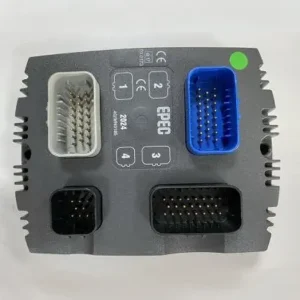
For example, an EPEC 2023/2024 controller may be a relevant hardware candidate for construction machinery, but its product family alone does not prove that the application program and parameters match a specific crane.
How can a repair shop verify a sample without risking the crane?
Verification should follow the machine manufacturer’s service and safety procedures and be performed by qualified personnel. Do not bypass interlocks or install an unidentified controller directly into unrestricted operation. Where suitable equipment and documentation exist, begin with identity, power and interface checks on a protected bench. Then use a controlled installation with the work area secured, motion limited and emergency-stop arrangements available.
| Acceptance stage | Check | Evidence to record |
|---|---|---|
| Incoming identity | Part number, revision, connector and physical condition | Photos and receiving record |
| Electrical screening | Supply and interface match before connection | Approved comparison sheet |
| Communication | Expected network recognition and diagnostic status | Diagnostic result or service record |
| Configuration | Required software and parameters are present | Version or loading record |
| Controlled function test | Inputs, outputs and safety-related behavior follow the approved procedure | Technician sign-off and exceptions |
| Batch release | Bulk units match the approved sample identity and documentation | Batch, label and packing record |
What evidence belongs in a replacement crane controller RFQ?
- Crane brand, model, serial number, production year and application
- Original controller manufacturer, complete part number and hardware revision
- Clear label, connector, mounting and pin photos
- Supply voltage, polarity and grounding arrangement
- Input/output map and connected-device list where available
- CAN protocol, baud rate and node/address information where available
- Firmware, application and parameter version or backup status
- Fault codes, symptoms, diagnostic history and reason for replacement
- Quantity, sample-first requirement and acceptance method
- Return, configuration and commissioning expectations
These fields also make price comparisons fairer. A lower price for an unconfigured unit may lead to extra programming, testing, freight and downtime, while a higher initial quotation may include the identity and configuration work needed for acceptance.
Frequently asked questions
Can a crane controller be ordered from a casing photo?
A photo can start identification, but it is not sufficient proof. Buyers should add the full label, revision, machine identity, connectors, electrical data and configuration evidence.
Does the same part number always mean the same controller configuration?
Not necessarily. Confirm the complete part number, hardware revision and software or parameter status for the proposed unit.
Will a controller work if its connectors fit?
Physical fit does not prove matching pinout, I/O allocation, communication or application software.
Does CAN bus support guarantee communication?
No. Protocol behavior, baud rate, addressing, message expectations, termination and network condition also matter.
Should an aftermarket controller be tested on the crane immediately?
Use a staged, documented verification process performed by qualified personnel. Avoid unrestricted installation of an unverified unit.
What if the original controller is completely dead?
Collect physical identity, machine and harness evidence, service records and any previous software backup, then define the remaining uncertainty in the RFQ.
Can a supplier guarantee that replacing the controller will solve the fault?
Not from compatibility evidence alone. Harness, sensors, network devices, power and other machine circuits may cause similar symptoms.
Prepare the controller evidence for project evaluation
Provide the machine identity, original controller label and revision, connector photos, supply and I/O information, CAN details where available, software or parameter status, fault history, quantity and sample acceptance plan. Jiemanda can use this evidence to review available controller options and prepare a more verifiable quotation. Send the information through the controller project inquiry page.
Feature Product
-
 Zoomlion Original Power Control Board – ...
🔹 Core Functions Multi-circuit Power Distrib...
-
 XCMG HC3900 Crane Upper Computer Mainboard
Key Selling Points OEM Direct Compatibility...
-
 Zoomlion Mobile Crane Load Moment Indicator (LM...
Product Overview This is an original equipment...