+86 18652221058
- English
- Chinese
- French
- German
- Portuguese
- Spanish
- Russian
- Japanese
- Korean
- Arabic
- Irish
- Greek
- Turkish
- Italian
- Danish
- Romanian
- Indonesian
- Czech
- Afrikaans
- Swedish
- Polish
- Catalan
- Esperanto
- Hindi
- Lao
- Albanian
- Amharic
- Armenian
- Azerbaijani
- Belarusian
- Bengali
- Bosnian
- Bulgarian
- Cebuano
- Chichewa
- Corsican
- Croatian
- Dutch
- Estonian
- Filipino
- Finnish
- Frisian
- Galician
- Georgian
- Gujarati
- Haitian
- Hausa
- Hawaiian
- Hebrew
- Hmong
- Hungarian
- Icelandic
- Igbo
- Javanese
- Kannada
- Kazakh
- Khmer
- Kurdish
- Kyrgyz
- Latin
- Latvian
- Lithuanian
- Luxembou..
- Macedonian
- Malagasy
- Malay
- Malayalam
- Maltese
- Maori
- Marathi
- Mongolian
- Burmese
- Nepali
- Norwegian
- Pashto
- Persian
- Punjabi
- Serbian
- Sesotho
- Sinhala
- Slovak
- Slovenian
- Somali
- Samoan
- Scots Gaelic
- Shona
- Sindhi
- Sundanese
- Swahili
- Tajik
- Tamil
- Telugu
- Thai
- Ukrainian
- Urdu
- Uzbek
- Vietnamese
- Welsh
- Xhosa
- Yiddish
- Yoruba
- Zulu
- Kinyarwanda
- Tatar
- Oriya
- Turkmen
- Uyghur

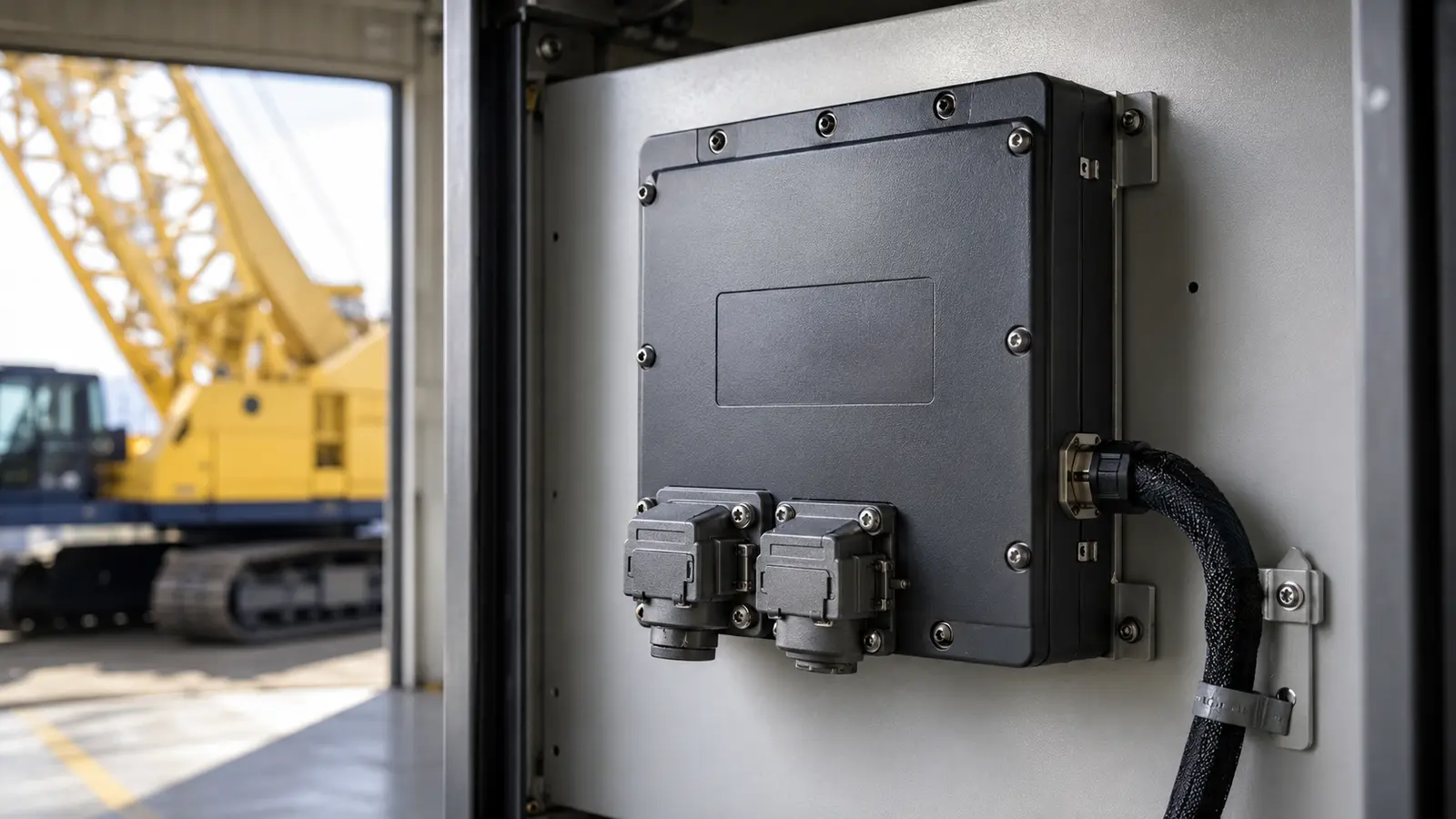
Direct Answer: Before buyers buy winch/crane hydraulic controllers, they should identify the controller’s exact function, full part number, crane model, connector arrangement, software or parameter version, operating condition and current physical state. For a legacy controller such as the WIKA iFLEX E5/0101, provenance, stored configuration data and an agreed functional test are as important as the housing and connector match.
A search for a “winch/crane hydraulic controller” may bring together several parts that perform different jobs. One unit may manage a crane safety or load-moment system, another may drive hydraulic functions, and another may control a winch motor or proportional valve. Buying by a broad market label creates a serious mismatch risk because the correct replacement is defined by the installed system, not by the seller’s keyword.
Jiemanda lists a range of construction machinery controllers for aftermarket sourcing. Buyers should still treat each inquiry as a component-identification task. The objective is not to find a box that looks similar; it is to establish whether the offered unit can communicate with the existing sensors, display, wiring and crane configuration.
Does the Search Term Describe the Controller You Actually Need?
Start by defining the failed function. Ask the maintenance team whether the fault concerns load-moment calculation, sensor signal acquisition, hydraulic motion, winch drive, engine control, communication or display output. The answer determines which controller family should be investigated.
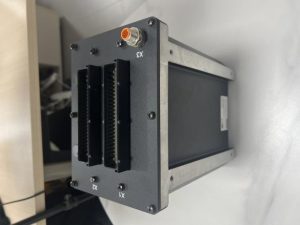
The listed WIKA iFLEX E5/0101 crane dedicated controller is described as a crane control unit that collects and processes signals associated with load-moment limiters, angle sensors and length sensors before issuing control commands. That description should not be generalized into proof that the unit fits every hydraulic or winch-control application.
A common buying mistake is sending only the phrase “crane controller” with a crane brand. One model series may use different electronics across production years, capacities or control-system revisions. The inquiry should therefore connect the requested controller to a specific machine, installed system and observed fault.
Why Does the iFLEX E5 Product Status Change the Buying Process?
WIKA Mobile Control’s public product-discontinuation information states that products in the iFLEX E5 series became obsolete in its portfolio effective October 1, 2021. This does not prove that every unit offered in the aftermarket is unusable. It means the buyer should approach the purchase as legacy-system support rather than assume normal current-production supply.
The commercial description must distinguish among unused old stock, a used original unit, a repaired unit, a remanufactured unit and a compatible alternative. Those categories can differ in condition, available configuration data, test scope and future serviceability. A quotation that says only “new” or “original” is not enough; the supplier should define what those words mean for that specific item.
Legacy status also raises a lifecycle question. If the crane will remain in service for years, the buyer may need one immediate replacement plus a plan for backups, data retention or a future retrofit. The lowest one-time purchase price may not be the lowest-risk decision if the system cannot be restored after the next failure.
Which Identity Evidence Should Be Matched Before Price Comparison?
Ask for clear photographs of the complete nameplate, every connector face, mounting points and the entire housing. Compare them with the removed controller, but do not stop at visual similarity. The full model suffix, hardware revision, serial information and any crane-OEM reference should be recorded exactly as displayed.
Part-number truncation is a frequent source of wrong shipments. Buyers sometimes copy the large family name while omitting a smaller suffix or revision line. That missing information may identify a different I/O arrangement or configuration. The RFQ should contain typed identifiers and original photographs so the supplier can cross-check both.
If the label is damaged, provide the crane manufacturer, crane model, serial number, year, controller location, mating connector photos and the identities of connected display and sensors. These details do not automatically prove compatibility, but they give the supplier a defensible basis for further verification.
How Should Buyers Verify Sensors, Harnesses and System Interfaces?
A controller works inside a signal chain. Confirm what supplies its inputs, what receives its outputs, how the network communicates and whether the existing harness has been modified. For crane safety systems, angle, length and load-related signals may be essential to the controller’s decisions.
Jiemanda’s crane angle sensor range and cable reel box range illustrate two adjacent component groups that can affect the same system. A controller replacement will not correct inaccurate data caused by a damaged sensor, poor cable-reel continuity, wiring fault or incorrect calibration.
- Record connector quantity, keying, pin count and cable direction.
- Confirm supply voltage and grounding at the installed connector.
- Identify CAN or other communication connections without guessing from wire color.
- Check whether sensor types and signal ranges match the original system.
- Document any splices, adapters, corrosion, water ingress or harness repairs.
An identical connector can still carry a different pin assignment. A buyer should not authorize installation from connector fit alone, especially when the controller participates in a safety-related crane function.
What Software and Parameter Information Must Follow the Hardware?
Hardware identity is only one layer. The controller may depend on crane-specific software, parameter files, load-chart data, calibration values or network settings. The buyer should ask whether the offered unit is blank, preconfigured, copied from another machine or supplied with data prepared for the stated crane.
Do not assume that a powered-up controller is ready for lifting operations. It may communicate but contain the wrong crane geometry, sensor scaling or configuration. Ask who is responsible for transferring or loading data, what source file will be used, how version control is handled and what information must be supplied by the buyer.
Before removing a partially functioning original unit, preserve any recoverable configuration and fault information. Replacing the hardware first and asking about data later can turn a repairable situation into a longer downtime event.
How Should the Condition of a Legacy Controller Be Assessed?
For a used or repaired unit, request photographs before cleaning or cosmetic refinishing where possible. Look for bent connector pins, cracked shells, damaged seals, corrosion, impact marks, burnt areas, repaired tracks and evidence of moisture. Cosmetic appearance should not substitute for an electrical and functional condition statement.
Ask the supplier to identify what was tested and what was not. “Tested” might mean only that the unit powers on, while the buyer may need communication, input acquisition and output behavior checked. The quotation should name the test boundary, test setup, recorded result and acceptance method.
Packaging is also part of condition control. Connector pins need physical protection, the housing needs immobilization, and electronics should be protected against electrostatic discharge and moisture during transport. A unit that passes a bench test can still arrive unusable after poor packing.
Which Evidence Should Be Reviewed Before Shipment?
| Decision Item | Evidence to Request | Risk if Omitted |
|---|---|---|
| Product identity | Full nameplate and connector photographs | Wrong variant or revision |
| Commercial condition | Written status: old stock, used, repaired or alternative | Condition dispute after delivery |
| Hardware fit | Dimensions, mounting and connector comparison | Unit cannot be installed |
| Configuration | Software or parameter responsibility statement | Hardware powers up but system remains unusable |
| Functional scope | Test checklist, photos or video tied to the offered unit | “Tested” means only power-on |
| Shipment protection | Packing method and connector protection confirmation | Transit damage to a scarce part |
Buyers who need a broader compatibility baseline can also review the site’s guide on replacement crane controller verification. For this iFLEX E5/0101 purchase, the added decision layer is legacy-product status and the evidence needed to support a specific offered unit.
What Should Installation and Acceptance Testing Cover?
Agree on the acceptance sequence before shipment. A sensible process separates receipt inspection, power and communication checks, sensor-value verification, configuration confirmation, no-load function checks and controlled operational testing. The exact procedure must follow the crane manufacturer’s service requirements and applicable site safety rules.
Do not bypass warnings or protection functions merely to make the crane move. If the new controller generates different data, alarms or outputs, stop and compare the system configuration, inputs and network condition. The fault may be outside the controller or may indicate that the offered unit is not correctly configured.
Define who can make software changes and who accepts the result. A remote supplier may help identify a part, but site commissioning remains dependent on qualified personnel with access to the crane and appropriate test conditions.
Representative Scenario: A Crawler Crane Needs a Legacy Controller
Representative scenario — not a claimed customer case.
Business Background: A crane-parts distributor must support an older crawler crane whose controller has intermittent communication faults.
Problem: The initial request contains only “iFLEX E5 controller” and a photograph of the front cover. Several visually similar listings appear at different prices.
Cause: The request omits the complete suffix, connector faces, crane serial information, system components, configuration status and required test scope.
Solution: The distributor collects the full labels from the original controller and display, photographs the connectors and harness, records the crane model and fault, preserves available configuration data, and asks each supplier to state item condition and test evidence.
Buyer Decision Value: The comparison changes from “which controller is cheapest” to “which offered unit has the strongest documented match and the clearest installation responsibility.”
What Information Should Be Sent With the Purchase Inquiry?
- Crane manufacturer, model, serial number and production year.
- Full controller model, suffix, hardware revision and all label photos.
- Photos of each connector, mounting position and existing harness.
- Connected display, angle sensor, length sensor and other system identifiers.
- Fault symptoms, diagnostic codes and actions already taken.
- Required item condition and whether repair or used stock is acceptable.
- Available software, parameter or backup information.
- Required test evidence, packing, delivery destination and acceptance terms.
Send this information through the Jiemanda contact page so the inquiry can be reviewed against the listed controller scope. A complete evidence package gives both buyer and supplier a clearer basis for identifying the offered part and defining unresolved risks.
Frequently Asked Questions
Can buyers order an iFLEX E5/0101 from the model name alone?
No. The complete label, suffix, connector arrangement, crane information and system configuration should be checked before ordering.
Does the same connector prove that a controller is compatible?
No. Physical fit does not confirm pin assignment, communication, software, sensor scaling or crane-specific parameters.
What does the iFLEX E5 series discontinuation mean for buyers?
It means procurement should be treated as legacy-system support. Buyers should define item condition, source, data availability, test scope and future replacement planning.
Should a used controller be tested only for power-on?
No. The buyer should define the functions that can be tested, including communication and relevant inputs or outputs, and understand anything the bench setup cannot verify.
Can a replacement controller fix wrong crane sensor readings?
Not necessarily. Incorrect readings may originate in sensors, cable reels, wiring, calibration, communication or configuration rather than the controller.
What should be confirmed before installing the replacement?
Confirm identity, condition, connector integrity, configuration responsibility, power and grounding, communication, sensor inputs and the approved acceptance procedure.
Feature Product
-
 Zoomlion Original Power Control Board – ...
🔹 Core Functions Multi-circuit Power Distrib...
-
 XCMG HC3900 Crane Upper Computer Mainboard
Key Selling Points OEM Direct Compatibility ...
-
 Zoomlion Mobile Crane Load Moment Indicator (LM...
Product Overview This is an original equipment...